

Publication date:
Nov 11, 2026
IMF Data Brief: Financial Soundness Indicators
Household Balance Sheets: Improving Ratios, but Potential Vulnerabilities Remain
Financial Soundness Indicators, Country data, Quarterly
Contributors: Hector Carcel Villanova, Mahmut Kutlukaya, Miguel Segoviano, Ibrahim Serwanja, and Annika Suri
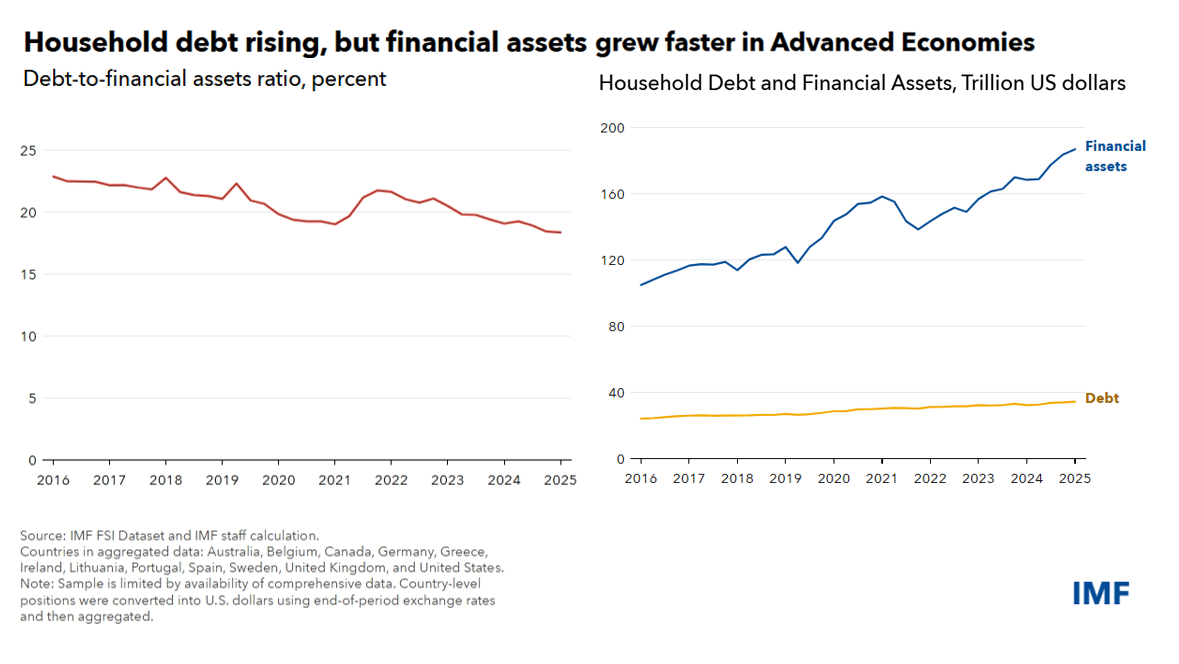
The household debt-to-financial-assets ratio declined from 22.9 percent in 2016 to 18.4 percent in 2025 (Figure 1), for a sample of advanced economies. Together with the declining household debt-to-GDP ratio, these trends may suggest reduced household balance sheet vulnerability.
However, the household debt-to-financial assets ratio masks a substantial increase in nominal household debt, which has been more than offset by an even faster increase in financial assets value. As a result, the improvement in the debt-to-financial-assets ratio could be sensitive to changes in financial asset values. In a scenario involving a significant decline in asset prices, household financial assets could lose value through both direct and indirect exposure channels. Direct exposures would reflect changes in the market value of households’ holdings of tradable financial instruments, particularly equity and investment fund shares, which account for a significant proportion of household financial assets in several countries. Indirect exposures could arise through insurance and pension entitlements, another major component of household financial assets, whose value may also be affected by changes in the value of assets held by pension funds and insurance corporations, including their significant holdings of tradable financial instruments.
Exposure to shocks varies with household balance-sheet composition, which differs markedly across the countries as illustrated in Figure 2. In some countries, households hold relatively larger proportions of financial assets, including tradable instruments—particularly equity and investment fund shares—and insurance and pension entitlements. In others, nonfinancial assets, largely real estate, constitute a large portion of households’ balance sheets. On the liability side, loans are the principal source of household leverage, although their relative size also varies across countries. These differences in asset and liability composition imply varying exposure and vulnerability to shocks, underscoring the importance of looking beyond aggregate debt levels when assessing household financial resilience.

Note to Readers
Financial soundness indicators (FSI) are internationally comparable measures of the financial resilience of a country’s financial sector and its nonfinancial counterpart sectors, compiled within the framework of the 2019 Financial Soundness Indicators Compilation Guide. Reported by member countries and disseminated by the International Monetary Fund, the FSI sectoral data cover deposit takers, pension funds, insurance corporations, money market funds, other financial corporations, nonfinancial corporations, and households, providing an extensive and valuable resource for surveillance, policymaking, and research.
FSI data covers 156 countries, 60 of which have reported some data through 2026Q2. The reporting frequency varies across countries, sectors, and indicators and may be monthly, quarterly, or annual. Accordingly, the analysis presented in this Data Brief is based on economies for which the relevant data is available.
Country-level data, metadata, and other supporting information are available on the IMF FSI webpage.
EMPOWERING THE WORLD WITH DATA
IMF Data is known for its high standard of quality and methodological consistency. With over 50 datasets updated regularly, you always have access to the latest global economic trends and forecasts as well as trusted data for cross country research and analysis.
Check our release calendar for upcoming releases:
