

Publication date:
—
Services Trade Expands at a Faster Pace Than Goods Trade
Datasets:
November 13 – 26, 2024

Annual Balance of Payments and International Investment Position, 2023, Country group aggregates
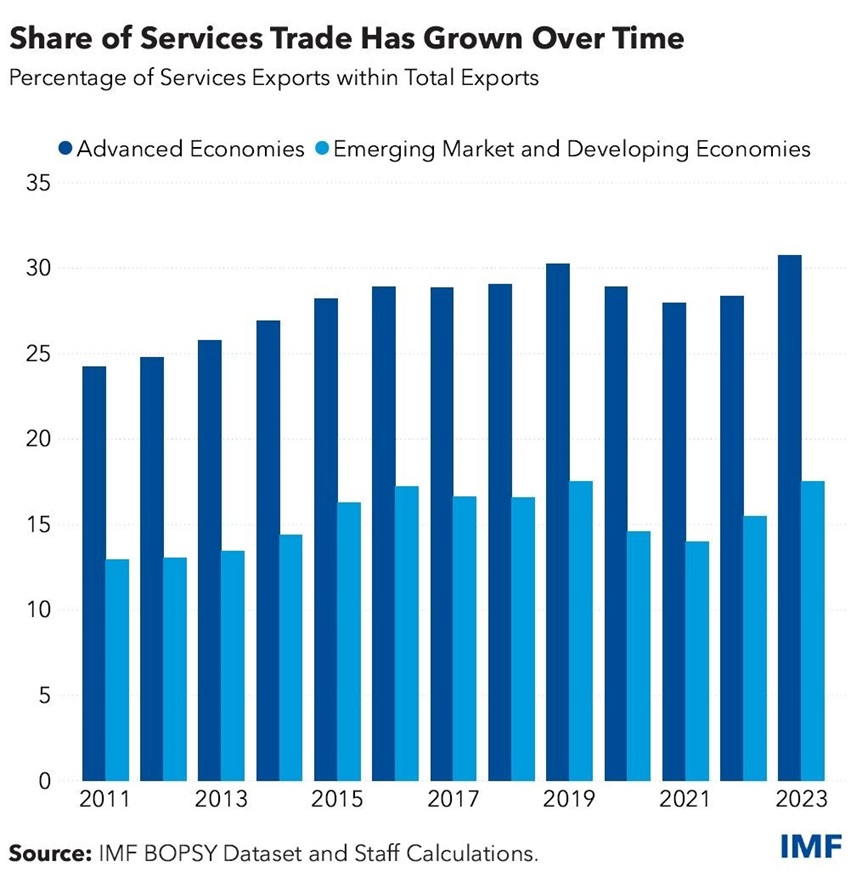
Over the last twelve years global trade in goods has increased by an average of 2.2 percent per year in nominal US dollar terms, while trade in services has grown more robustly at 4.7 percent annually. Over the same period, the global economy (measured by world GDP in US dollars) expanded at a rate of 3.0 percent per year. Emerging Market and Developing Economies (EMDEs) have seen a 5.7 percent growth in service exports, compared to 4.6 percent for Advanced Economies (AEs). In 2023, services accounted for 31 percent of total exports in AEs, versus 17 percent in EMDEs. The share of services trade in total world trade rose from 20 percent in 2011 to 25 percent in 2023. The growth reflects, among other factors, the growing importance of digitalization, which has facilitated the delivery of services across borders.
Global Cross-Border Assets Holdings Rebound in 2023
After declining in 2022, the value of global cross-border asset holdings increased in 2023. Both AEs and EMDEs contributed to the upturn. The longer term increasing cross-border holdings of assets indicates a growing global interconnectedness.
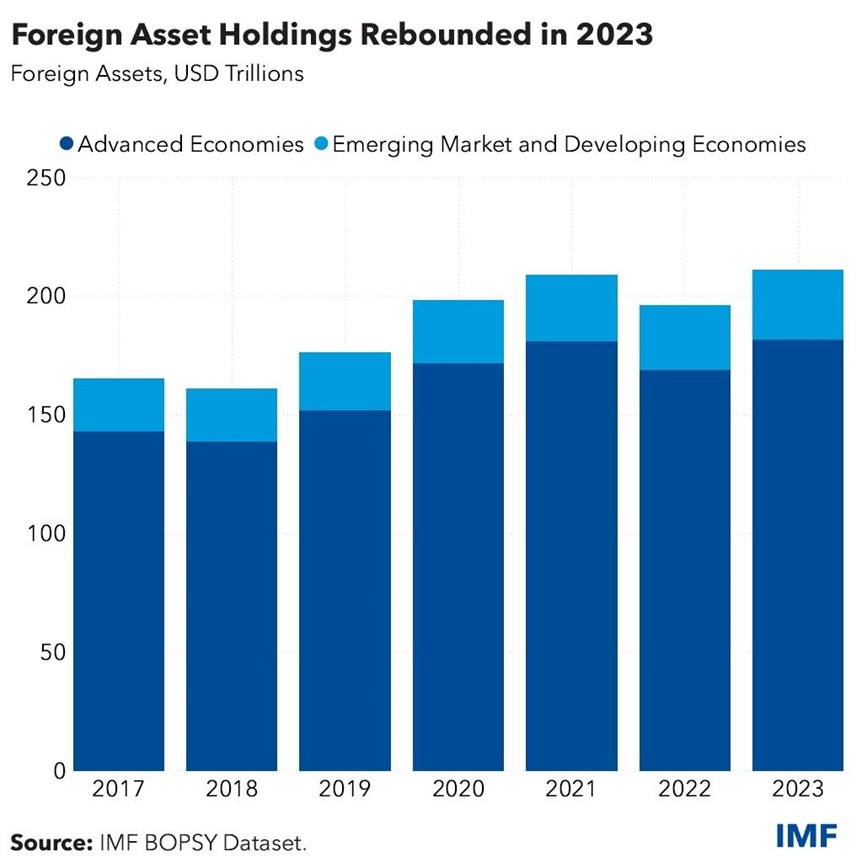
The increase in cross-border asset holdings in 2023 is largely due to valuation changes reflecting a broad recovery of equity prices through 2023, as well as appreciation of the euro and other currencies against the US dollar (as the International Investment Position is recorded in US dollars, a stronger currency against the US dollar increases the value of non-dollar assets).
Historically, fluctuations in AE asset holdings have largely been driven by valuation changes, reflecting movements in asset prices and in exchange rates against the US dollar. On the other hand, for EMDEs, changes in assets are mainly driven by transactions, with relatively small fluctuations coming from other changes.
Notes: The IMF’s Balance of Payments Statistical Yearbook 2024 (BOPSY) was published on the IMF website on November 20, 2024. It shows country, regional and world aggregates of headline Balance of Payments and International Investment Position variables. The tables are based on data reported to the IMF by country authorities, with estimates made for missing country data, to the extent possible, in the computation of regional totals. BOPSY provides tables by country on a BPM6 basis for the years 2011 to 2023. Data for the period 2005 to 2010 are available in the archive.
Global Money Supply Returning to Gradual Expansion
Monthly Monetary and Financial Statistics, June 2024, Country data and country group aggregates
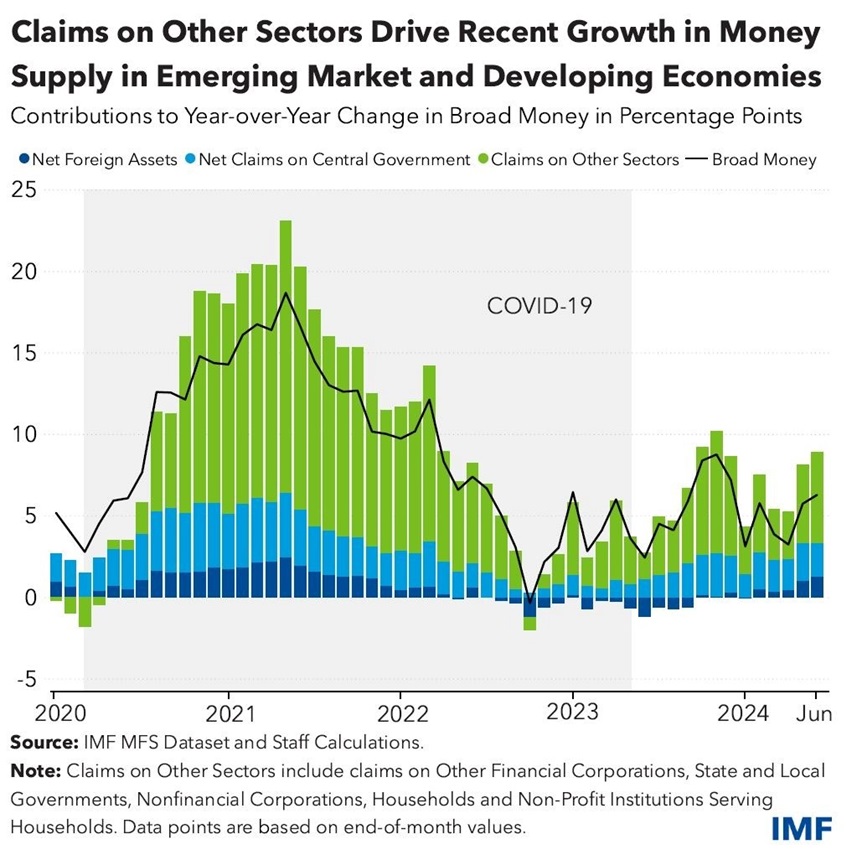
Global money supply (or broad money) continued the trend of gradual expansion that started in 2023, recording an annual increase of 3.1 percent in June 2024. This growth rate was significantly higher than the modest 0.7 percent growth observed a year earlier and essentially in line with pre-pandemic levels.
Throughout the COVID-19 pandemic, accommodative monetary policies adopted by central banks worldwide led to a significant surge of global money supply that reached a peak annual growth of 17.6 percent at end-February 2021—the highest since the global financial crisis. Subsequently, with emerging inflationary pressures, most central banks shifted towards tighter monetary policy. This shift substantially slowed the global money supply growth for more than two years, even turning it negative in second half of 2022 and early 2023.
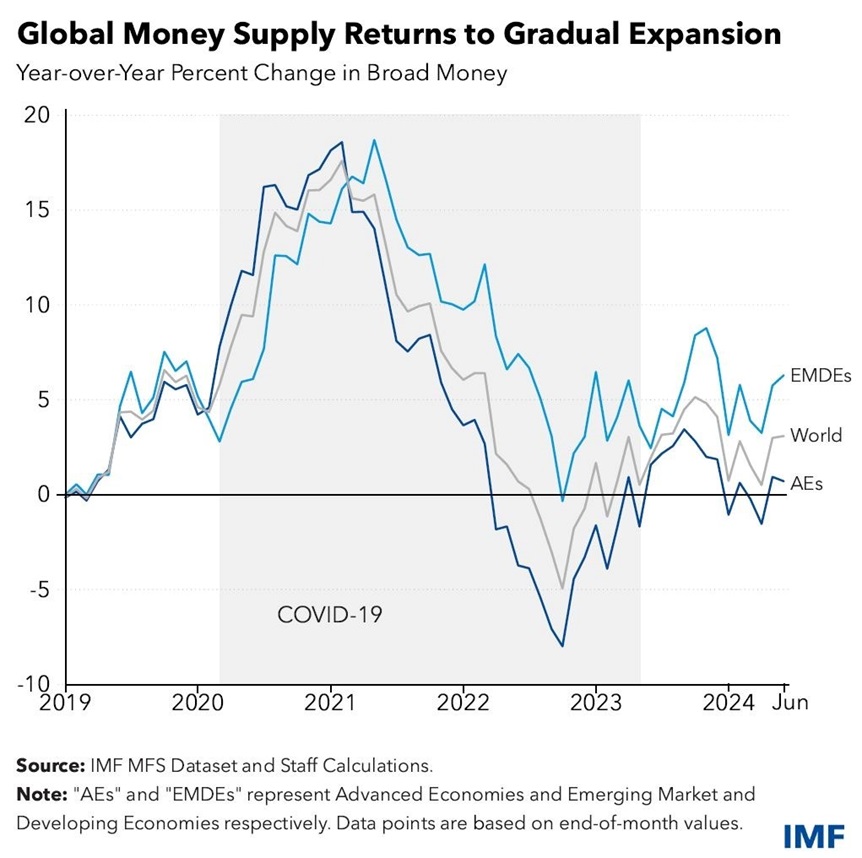
Average broad money growth was relatively stable in both the Advanced Economies (AEs) and Emerging Market and Developing Economies (EMDEs) during the first half of 2024, with higher rates observed in EMDEs. This contrasts with 2020, when the average money supply growth in AEs exceeded the growth in EMDEs.
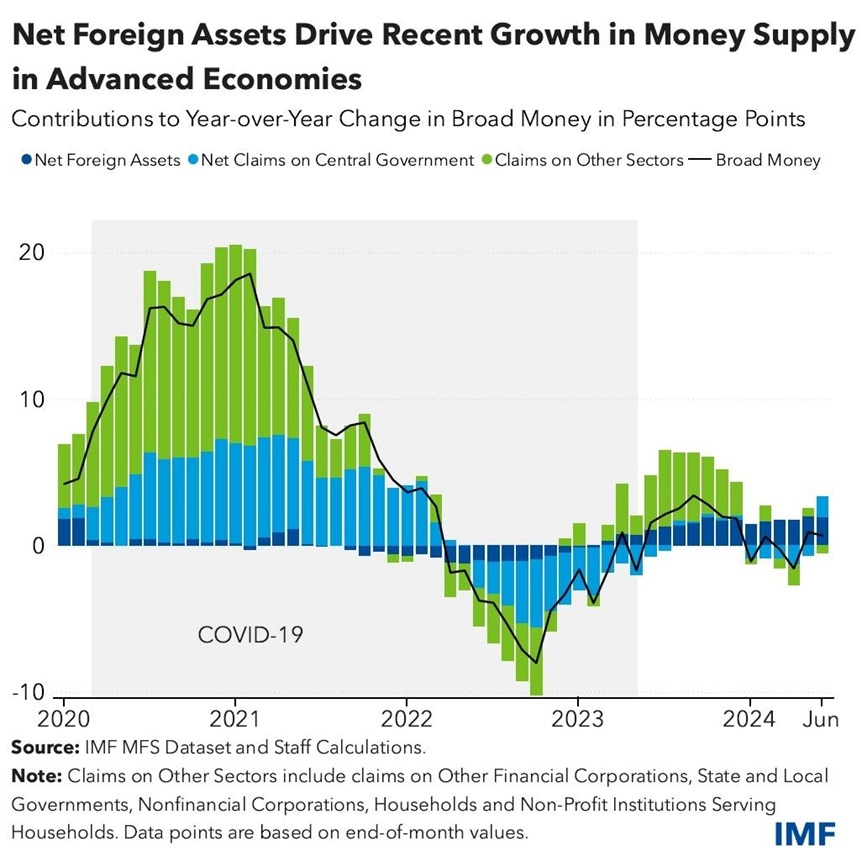
Looking at broad money counterparts, net foreign assets contributed the most to its growth in AEs during the first six months of 2024, while claims on other domestic sectors were the main driver of growth in EMDEs. For AEs, compared to the pre-COVID-19 pandemic period there has been a notable shift as from 2020, when net claims on central government and claims on other domestic sectors contributed the most to broad money growth, reflecting fiscal expansion and increased borrowing by other domestic sectors.
OTHER RELEASES
World Industrial Production Up 0.2 percent in August 2024Monthly Index of Industrial Production, July 2024, Country data and country group aggregates World industrial production (IP) rose 0.2 percent in August 2024 following July when IP was unchanged. This increase was mainly driven by an expansion in Advanced Economies (AEs), which grew 0.6 percent.
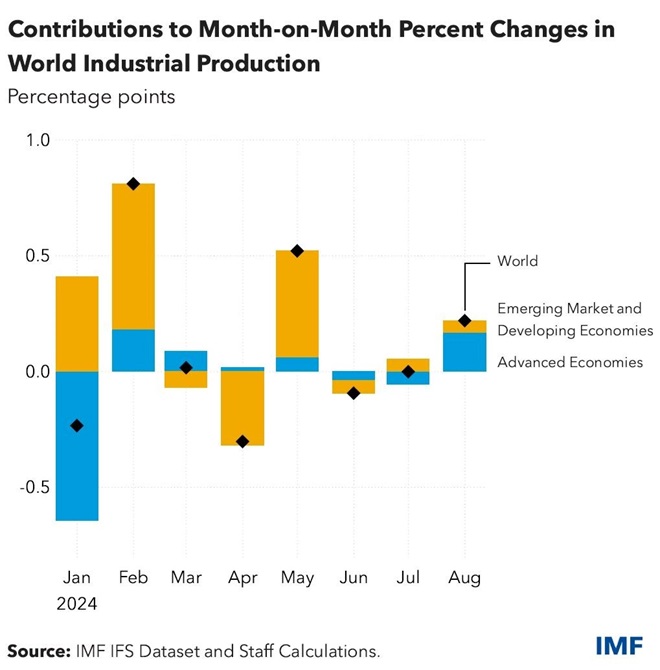
Notes: 1. Seasonally adjusted World and Country Groups Aggregate estimates are based on a sample of 123 economies that disseminate an Industrial Production (IP) index. 2. Country Groups Aggregate grouping are based on WEO classification.
|
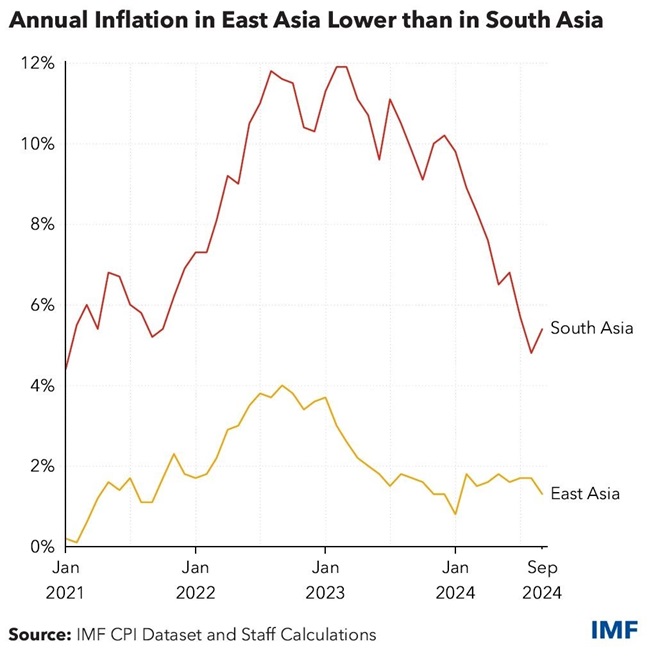
Annual Inflation Lower in East Asia than in South AsiaMonthly Consumer Price Indexes, August 2024, Country data and country group aggregates.East Asia’s annual inflation continues to be much lower than annual inflation for the South Asia region. Regional annual inflation for East Asia economies declined to 1.3 percent in September 2024 from 1.7 percent in August 2024. Annual inflation for South Asia increased in September 2024 to 5.4 percent from 4.8 percent in August 2024. Over the last 10 years, annual inflation in East Asia has not exceeded 4 percent and has remained around 2 percent or less for most of the period. In contrast, annual inflation in South Asia has been more volatile across the same period, reaching a 10-year high of 11.9 percent in March 2023. Since December 2023, when annual inflation was at 10.3 percent, inflation for South Asia has been trending downward.
Notes: Regional annual inflation is calculated as a weighted average using officially disseminated indexes and purchasing power parity (PPP) expenditure data. East Asia: Brunei Darussalam, China, Peoples Republic of, Hong Kong SAR, People’s Republic of China, Indonesia, Japan, Cambodia, Korea, Republic of, Lao PDR, Macao SAR, People’s Republic of China, Mongolia, Malaysia, Philippines, Singapore, Thailand, Timor-Leste, Democratic Republic of, Vietnam, Australia, New Zealand. South Asia: Bangladesh, Bhutan, India, Sri Lanka, Maldives, Nepal, Pakistan
|
Balance of Payments and International Investment Position, Second Quarter 2024Balance of Payments and International Investment Position referent the second quarter of 2024 were released on November 20, 2024. The IMF tracks the quarterly Balance of Payments and International Investment Position across 190 countries with data starting from 1945. |
Real Effective Exchange Rates, October 2024Real Effective Exchange Rates for September 2024 were released on November 25, 2024. Real Effective Exchange Rates are available for 93 countries. |
Atmospheric CO₂ Concentrations, October 2024Atmospheric CO₂ Concentrations for October 2024 were released on November 12, 2024.The IMF Climate Change Indicators Dashboard tracks monthly atmospheric carbon dioxide concentrations. |
UPCOMING RELEASES
| November 28, 2024 |
Quarterly GHG Emissions, Second Quarter 2024The IMF tracks the annual and seasonally adjusted quarterly Greenhouse Gas (GHG) Air Emissions Accounts across 20 regions and country groups with data starting from 2010. |
| November 28, 2024 |
Trade in Low Carbon Technology Products, 2023Low carbon technology products produce less pollution compared to traditional technologies and therefore will play a vital role in the transition to a low carbon economy. The IMF tracks annual Trade in Low Carbon Technology Products for 204 economies, with records available since 1994. |
| November 28, 2024 |
Bilateral Trade in Low Carbon Technology Products, 2023The IMF tracks annual Bilateral Trade in Low Carbon Technology Products (trade in Low Carbon Technology Products by partner economy) for 204 economies, with records available since1994.
|
| December 6, 2024 |
International Merchandise Trade Statistics, Country Data and Country Group Aggregates,
|
EMPOWERING THE WORLD WITH DATA
IMF Data is known for its high standard of quality and methodological consistency. With over 50 datasets updated regularly, you always have access to the latest global economic trends and forecasts as well as trusted data for cross country research and analysis.
