

Publication date:
Sep 30, 2026
IMF Data Brief: Currency Composition of Official Foreign Exchange Reserves
World Official Foreign Currency Reserves Increased Slightly in the Second Quarter of 2026
IMF Currency Composition of Official Foreign Exchange Reserves, World Aggregates, Second Quarter of 2026
Contributors: Erin Nephew, Hannah Wei, and Abdulrahman Gweder.
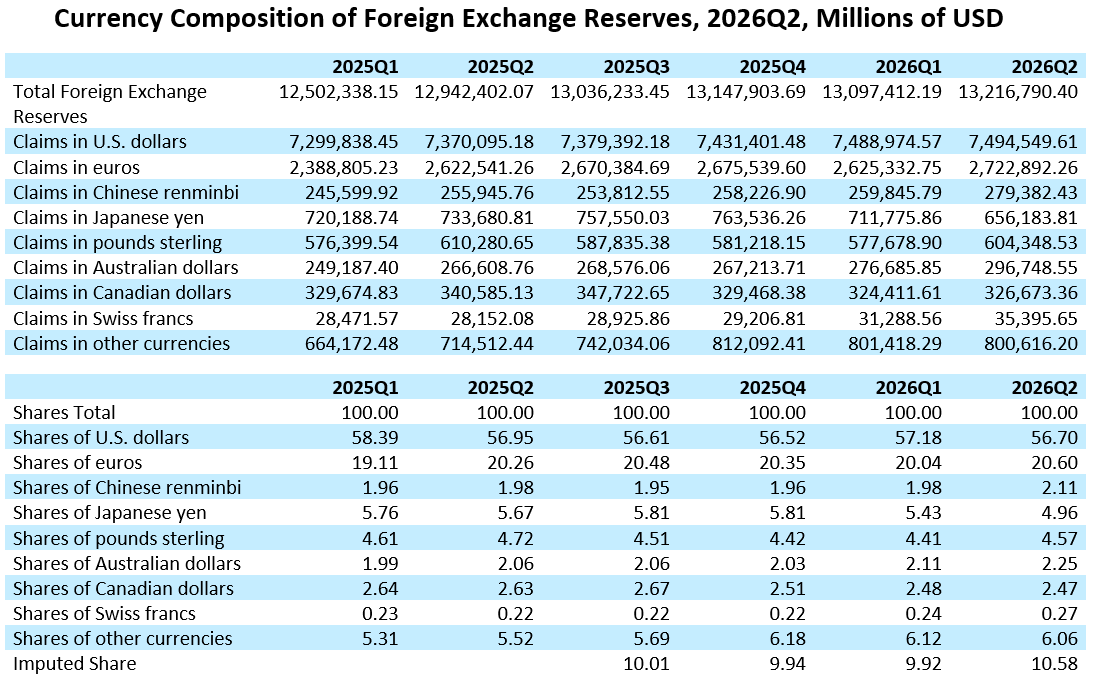
The IMF’s latest Currency Composition of Official Foreign Exchange Reserves (COFER) data show that total foreign exchange reserves increased to $13.22 trillion in 2026Q2, up slightly from $13.10 trillion in 2026Q1.
Although claims in U.S. dollars were largely unchanged in 2026Q2, the dollar's share of global foreign exchange reserves declined to 56.70 percent, from 57.18 percent in the previous quarter, as reserve holdings in euro and several other currencies increased. As exchange rate movements were range-bound within about +/- 2 percent this quarter, exchange-rate valuation effects were limited, suggesting that the shifts in currency shares in 2026Q2 largely reflected other price changes and/or portfolio reallocations.
Claims in euro increased by nearly $100 billion in 2026Q2, accounting for most of the increase in total foreign exchange reserves. The euro’s share of global foreign exchange reserves increased to 20.60 percent in 2026Q2, from 20.04 percent in 2026Q1, marking the largest increase in both claims and share among reported currencies, due mostly to active purchasing. The renminbi’s share also edged up to 2.11 percent from 1.98 percent, as did the pound sterling, Australian dollar, and Swiss franc, which increased modestly by 0.16, 0.13, and 0.03 percentage points, respectively.
In contrast, claims in Japanese yen declined in 2026Q2. The yen's share fell to 4.96 percent, from 5.43 percent in 2026Q1, continuing the downward trend observed last quarter. The fall in the yen share is due to a combination of active selling, a rise in Japanese bond yields (which add to the decline by reducing the value of yen-denominated securities), and yen depreciation (which, though modest in Q2, also exerted some downward pressure). These developments occurred against a backdrop of broader pressures on the yen, followed by a joint U.S.-Japan intervention in Q3.
The shares of Canadian dollar and “Other currencies” also edged slightly lower, declining by 0.01 and 0.06 percentage points, respectively, although the latter remained above 6 percent of total foreign currency reserves.
EMPOWERING THE WORLD WITH DATA
IMF Data is known for its high standard of quality and methodological consistency. With over 50 datasets updated regularly, you always have access to the latest global economic trends and forecasts as well as trusted data for cross country research and analysis.
Check our release calendar for upcoming releases:
