

Publication date:
Oct 29, 2025
IMF Data Brief: Financial Access Survey
Datasets:
Fintech Expands Financial Services Access, Fast Outpacing Traditional Banking
Financial Access Survey, Annual Country Data
Contributors: Fozan Fareed, Katia Huayta, Dinh Nguyen-Xuan, Miguel Segoviano, Alexander Tromp, Huong Lan Vu
Digital financial services, including mobile money and mobile and internet banking, are transforming how people access financial services. The 2025 FAS Annual Report—with the accompanying full dataset for 163 countries—reveals the scale and pace of this transformation. The FAS team is expanding data coverage to include digital financial services such as e-money, e-wallets, fintech and peer-to-peer lending, crowdfunding, neobanks, and mobile money-enabled products, to be released at a later stage.
This trend is particularly clear in Emerging Market and Developing Economies (EMDEs), where digital transactions more than quadrupled between 2017 and 2024 with digital adoption accelerating sharply after 2020, as the pandemic drove behavioral shifts across regions (Figure 1).
The shift is most dramatic in Sub-Saharan Africa: between 2018 and 2024, the region added 100 mobile money accounts for every 50 additional deposit accounts per 100 adults. Mobile money has become the dominant form of financial access, outnumbering traditional deposit accounts by more than two to one (Figure 2).
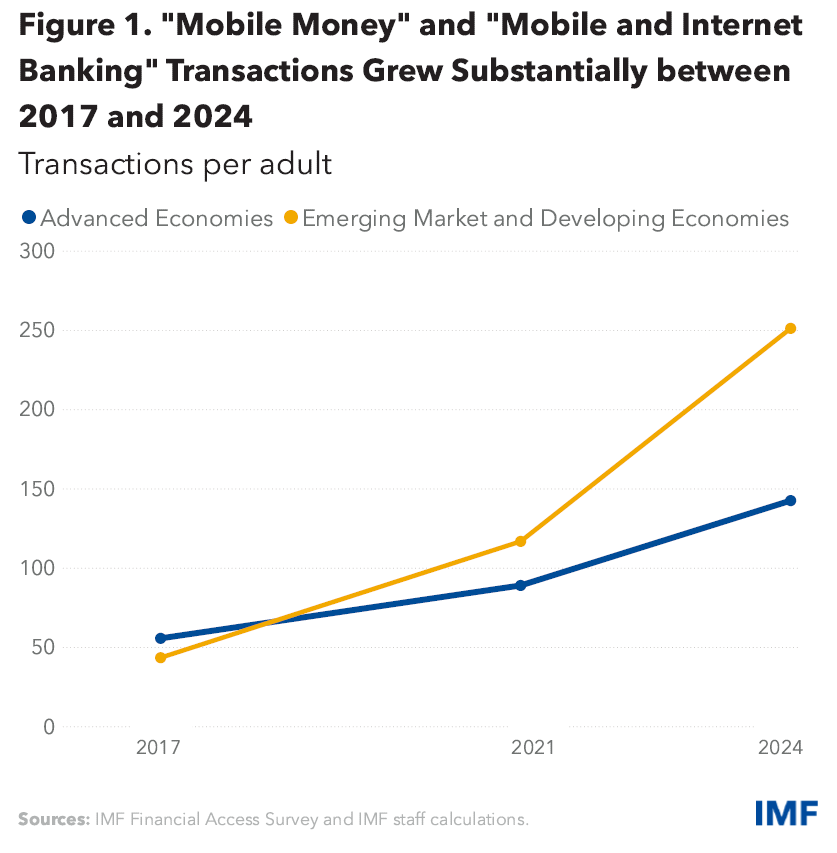
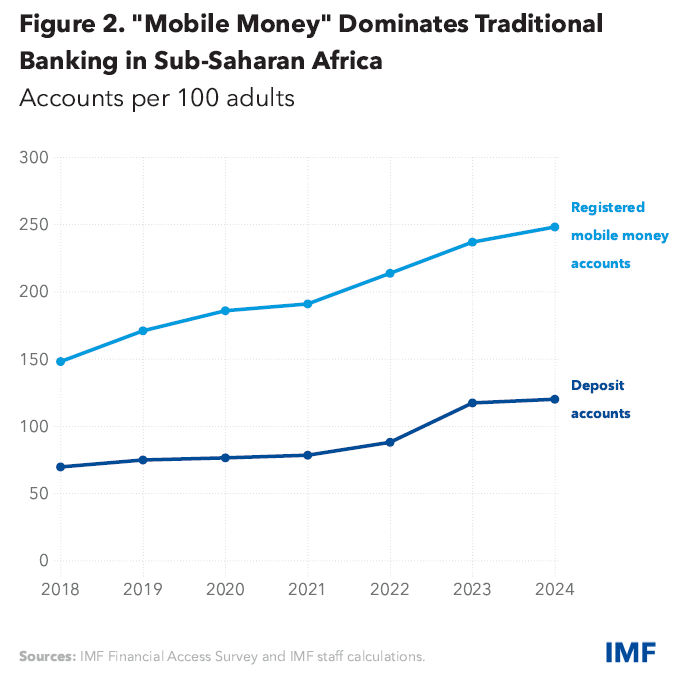
Notes: The regional weighted averages are calculated using only the economies with available data for the respective periods. Mobile money is a digital medium of exchange and store of value using mobile money accounts, facilitated by a network of mobile money agents. A bank account is not required to use mobile services. Most Advanced Economies do not report mobile money data because the service does not exist. Mobile and internet banking is the use of an application on a mobile or another electronic device to execute banking services.
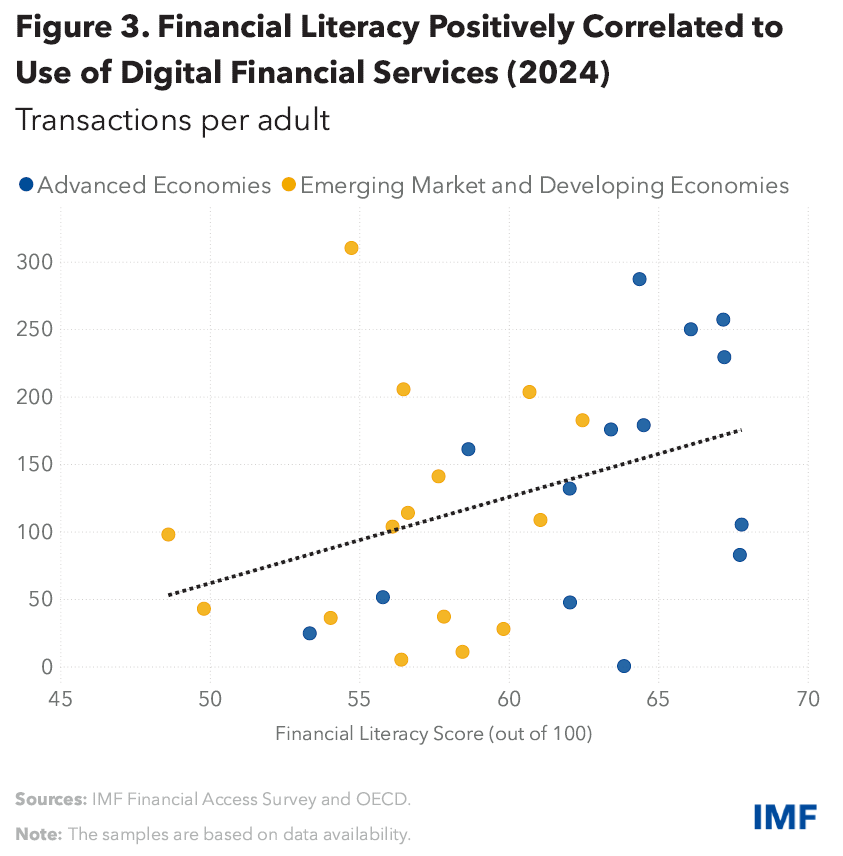
FAS data also reveal a positive relationship between financial literacy and the adoption of digital financial services across countries, for both Advanced Economies and EMDEs (Figure 3).
OTHER RELEASES
Financial Development IndexCountry Data and Country Group Aggregates, 2023
The Financial Development Index for 2023 was released on October 6, 2025. The dataset contains nine indices that summarize how developed financial institutions and financial markets are in terms of their depth, access, and efficiency. These indices are aggregated into an overall index of financial development. |
World Economic Outlook (WEO)Country Data and Country Group Aggregates, October 2025
The World Economic Outlook was released on October 14, 2025. The WEO is a survey of prospects and policies by the IMF staff, usually published twice a year, with updates in between. |
Sub-Saharan Africa Regional Economic Outlook (AFRREO)Country Data and Country Group Aggregates, October 2025
The Sub-Saharan Africa Regional Economic Outlook was released on October 16, 2025. This report discusses recent economic developments and prospects for countries in the Sub-Saharan Africa region. |
Western Hemisphere Regional Economic Outlook (WHDREO)Country Data and Country Group Aggregates, October 2025
The Western Hemisphere Regional Economic Outlook was released on October 20, 2025. This report discusses recent economic developments and prospects for countries in the Western Hemisphere region. |
Middle East and Central Asia Regional Economic Outlook (MCDREO)Country Data and Country Group Aggregates, October 2025
The Middle East and Central Asia Regional Economic Outlook was released on October 21, 2025. This report discusses recent economic developments and prospects for countries in the Middle East and Central Asia region. |
Fiscal MonitorCountry Data and Country Group Aggregates, October 2025
The Fiscal Monitor was released on October 23, 2025. The monitor is prepared twice a year by the IMF’s Fiscal Affairs Department. Its projections are based on the same database used for the World Economic Outlook (WEO) and the Global Financial Stability Report (GFSR). |
Effective Exchange Rate (EER)Country Data, September 2025
Effective Exchange Rates for September 2025 were released on October 27, 2025. The IMF tracks the monthly real effective exchange rates across 92 countries with data since 1948. |
Consumer Price Index (CPI)World and Country Aggregates, August 2025
Consumer Price Index data for August 2025 were released on October 29, 2025. The CPI dataset provides monthly price indexes at world and country aggregate levels, based on published national CPIs all-item indexes. |
Industrial ProductionWorld and Country Group Aggregates, July 2025
Industrial Production data for July 2025 were released on October 29, 2025. The Index of Industrial Production (IIP) describes changes in volume of industrial goods produced over time. Its main purpose is to provide a measure of the short-term changes in output over the reference period. IIP data set provides monthly volume indexes at world and country aggregate levels, based on published total IIP. |
EMPOWERING THE WORLD WITH DATA
IMF Data is known for its high standard of quality and methodological consistency. With over 50 datasets updated regularly, you always have access to the latest global economic trends and forecasts as well as trusted data for cross country research and analysis.
Check our release calendar for upcoming releases:
