

Publication date:
Nov 26, 2025
IMF Data Brief: Balance of Payments and International Investment Position Statistics (BOP/IIP)
Large Current Account Discrepancies are Persistent at the Global Level
Balance of Payments and International Investment Position Statistics (BOP/IIP), World and Country Group Aggregates, December 2024
Contributors: Maja Gavrilovic, Abdulrahman Gweder, Arushi Kapoor, Patrick Quill, Haruko Sakai
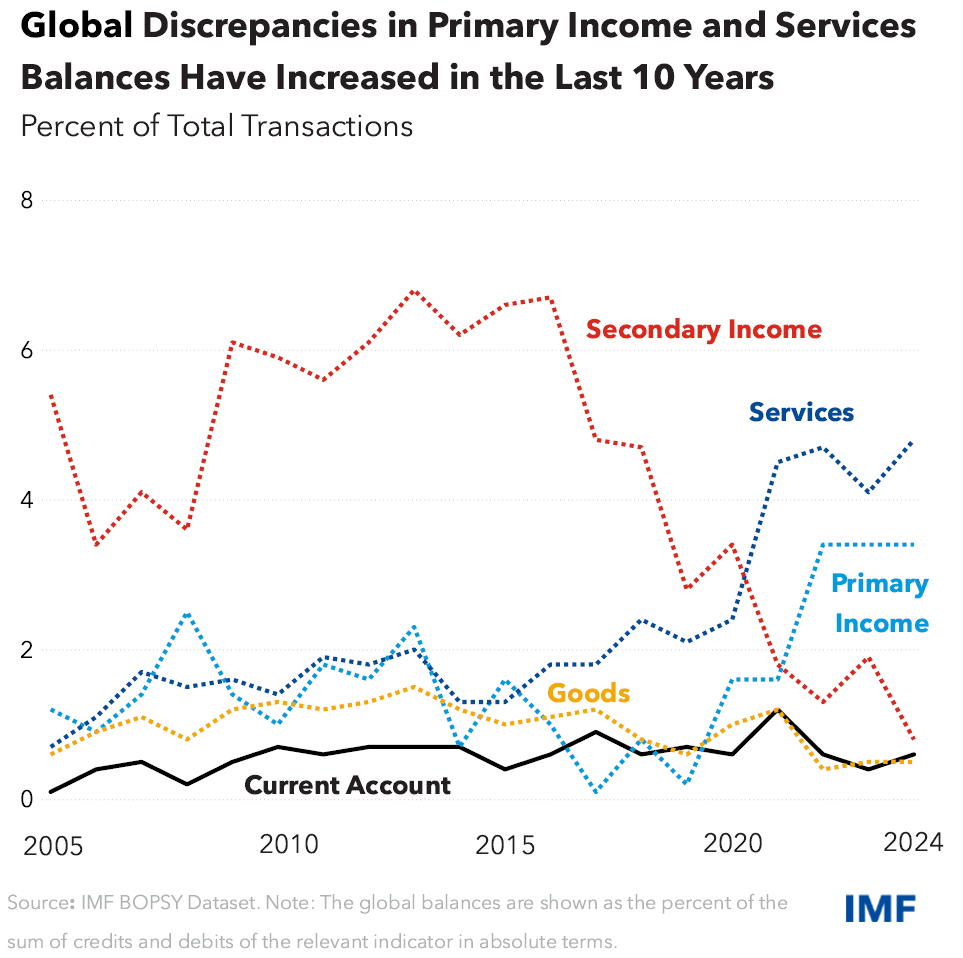
The global current account balance reached almost USD500 billion in 2024, according to the latest BOPSY data. The large positive discrepancy is mainly driven by the services account and, to a lesser extent, the goods account, partly offset by discrepancies of the opposite sign in the primary income account. The global current account should sum to zero, so when it does not, it signals inconsistencies or gaps in underlying data—such as misclassification, missing flows, or asymmetric recording across countries. This impedes economists’ ability to reliably assess global imbalances, external vulnerabilities, and the true nature of cross-border financial and trade relationships. The IMF monitors these discrepancies on an annual basis and works with countries to determine the cause and works to develop solutions that address these discrepancies.
Over the past 20 years, discrepancies in the components of current account have shifted substantially. Discrepancies in the goods account have been relatively stable. While secondary income account discrepancies have been large, reaching 6.8 percent of total transactions in 2013, they have declined markedly since 2016. During the same time, discrepancies in primary income and services accounts have increased substantially.
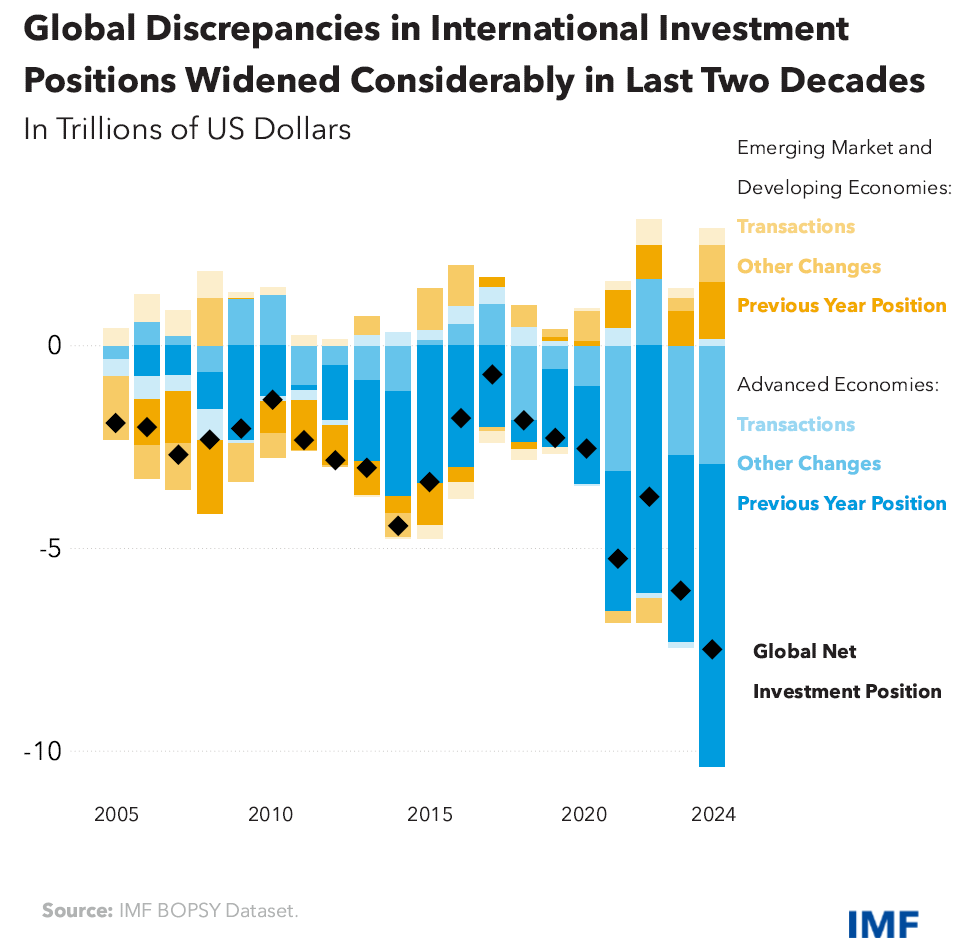
Global discrepancies in the International Investment Position have widened considerably in the last two decades.
Discrepancies in the global international investment position (IIP) reached an estimated USD -7.5 trillion in 2024. Advanced economies account for USD -10.2 trillion of this gap, partly offset by USD +2.7 trillion in emerging and developing economies. By definition, the global net IIP should be positive reflecting the global stock of monetary gold (which does not have an offsetting liability).
Deviations have grown larger in recent years. Both global assets and liabilities in the IIP increased, driven primarily by revaluations (exchange rate and other price changes), and to a smaller degree, by transactions. However, the rise in liabilities in advanced economies has not been matched by an increase in assets, either within advanced or emerging and developing economies.
OTHER RELEASES
Tax and Benefits Analysis Tool (TAXFIT)Country Data and Country Group Aggregates, December 2025
Tax and Benefits Analysis Tool for December 2025 was released on November 21, 2025. TaxFit is a microsimulation model that computes taxes and benefits-including income taxes, social security contributions, social assistance, care, family, and in-work-benefits-for households whose characteristics are defined by user provided information about gross incomes and family structures. |
Effective Exchange RatesCountry data, October 2025
Effective Exchange Rates for October 2025 were released on November 24, 2025. The IMF tracks the monthly real effective exchange rates across 92 countries with data since 1948. |
Trade in Low Carbon Technology Goods (TEG)World, Bilateral and Country Aggregates, 2024
Trade in Low Carbon Technology Goods (TEG) data for 2024 was released on November 26, 2025. TEG is a comprehensive database of indicators that track international trade in goods that produce less pollution than their traditional energy counterparts and are expected to play a vital role in the transition to a low carbon economy. The database covers more than 200 economies and provides annual data from 1994 onwards. |
EMPOWERING THE WORLD WITH DATA
IMF Data is known for its high standard of quality and methodological consistency. With over 50 datasets updated regularly, you always have access to the latest global economic trends and forecasts as well as trusted data for cross country research and analysis.
Check our release calendar for upcoming releases:
