

Publication date:
Jul 01, 2026
IMF Data Brief: Currency Composition of Official Foreign Exchange Reserves
World Official Foreign Currency Reserves Largely Unchanged in the First Quarter of 2026
IMF Currency Composition of Official Foreign Exchange Reserves, World Aggregates, First Quarter of 2026
Contributors: Abdulrahman Gweder, Erin Nephew, and Hannah Wei
Total foreign exchange reserves decreased to $13.10 trillion in 2026Q1, down slightly from $13.15 trillion in 2025Q4.
.png)
The share of US dollar holdings in foreign exchange reserves increased to 57.13 percent in 2026Q1, from 56.42 percent in 2025Q4. In 2025, gold surpassed US Treasuries as a share of official reserves, but that development was driven almost entirely by gold price valuation effects and is not reflected in COFER’s dollar share, which has remained broadly stable. The U.S. dollar’s mild appreciation against major currencies was a key driver of the COFER dollar share this quarter, with exchange-rate-driven valuation effects accounting for around half of the increase in its share.
The euro’s share declined to 20.03 percent in 2026Q1, from 20.38 percent in 2025Q4, while the renminbi’s share edged up to 1.99 percent from 1.95 percent. For both currencies, modest exchange rate valuation effects were the dominant driver of their changes.
Among other major currencies, the Japanese yen recorded the largest decline, falling from 5.84 percent in 2025Q4 to 5.44 percent, or 0.4 percentage points, in 2026Q1. The shares of pound sterling and Canadian dollar also edged down slightly in 2026Q1 relative to 2025Q4, by 0.01 and 0.02 percentage points, respectively. By contrast, the shares of the Australian dollar and Swiss franc increased modestly by 0.09 and 0.02 percentage points, respectively.
In contrast to the euro and renminbi, exchange rate valuation effects were less central for the Japanese yen and Swiss franc, where other factors appear to have played a larger role. Quarter to quarter movements in reserve currency shares can be influenced by a combination of factors other than exchange rate changes, including active management (the buying and selling of reserve assets) and valuation effects due to other price changes (changes in interest rates that affect the market value of government bonds). This quarter, the Japanese yen and Swiss franc had outsized movements in benchmark bond yields, relative to other reserve currencies. These movements in bond yields can both reflect active buying and selling in the markets for bonds denominated in those currencies and result in price-change-driven valuation effects on reserve managers’ holdings of those bonds.
Meanwhile, the residual “other currencies” category—covering currencies not separately identified in COFER—remained above 6 percent, despite declining to 6.18 percent in 2026Q1 from 6.25 percent in 2025Q4, marking the first decrease after seven consecutive quarters starting in 2024Q1.
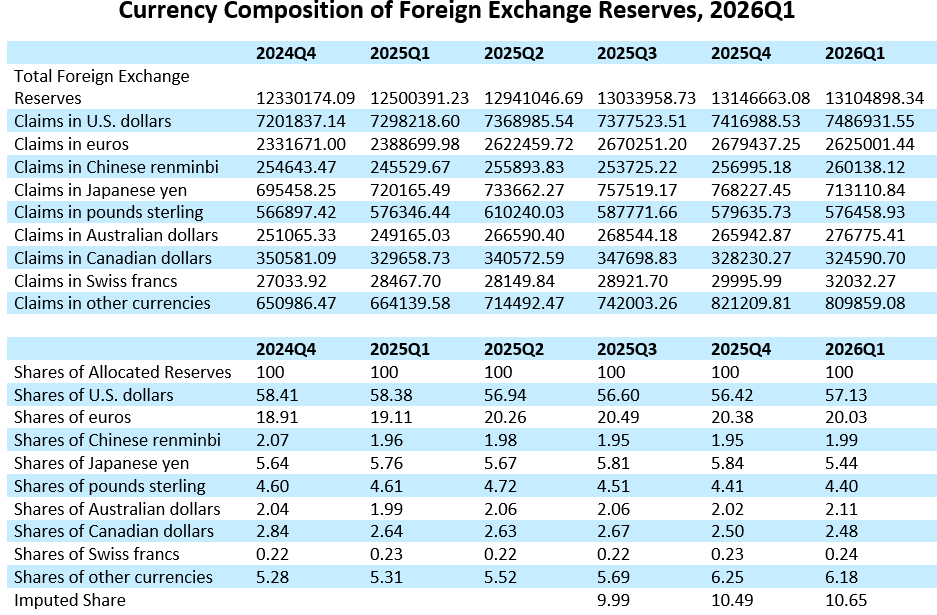
Note: Per the usual procedures, COFER data for prior quarters have been revised based on updated reporting, including the correction of reporting errors involving the Swiss franc. The revisions have only marginal impact on total reserves.
EMPOWERING THE WORLD WITH DATA
IMF Data is known for its high standard of quality and methodological consistency. With over 50 datasets updated regularly, you always have access to the latest global economic trends and forecasts as well as trusted data for cross country research and analysis.
Check our release calendar for upcoming releases:
