

Publication date:
Aug 26, 2026
IMF Data Brief: World and Regional Inflation
Global Inflation Eased Slightly in June 2026 After a Gradual Acceleration Earlier in the Year
World and Country Group CPI Aggregates, June 2026
Contributors: Abdulrahman Gweder and Ragnhild Nygaard
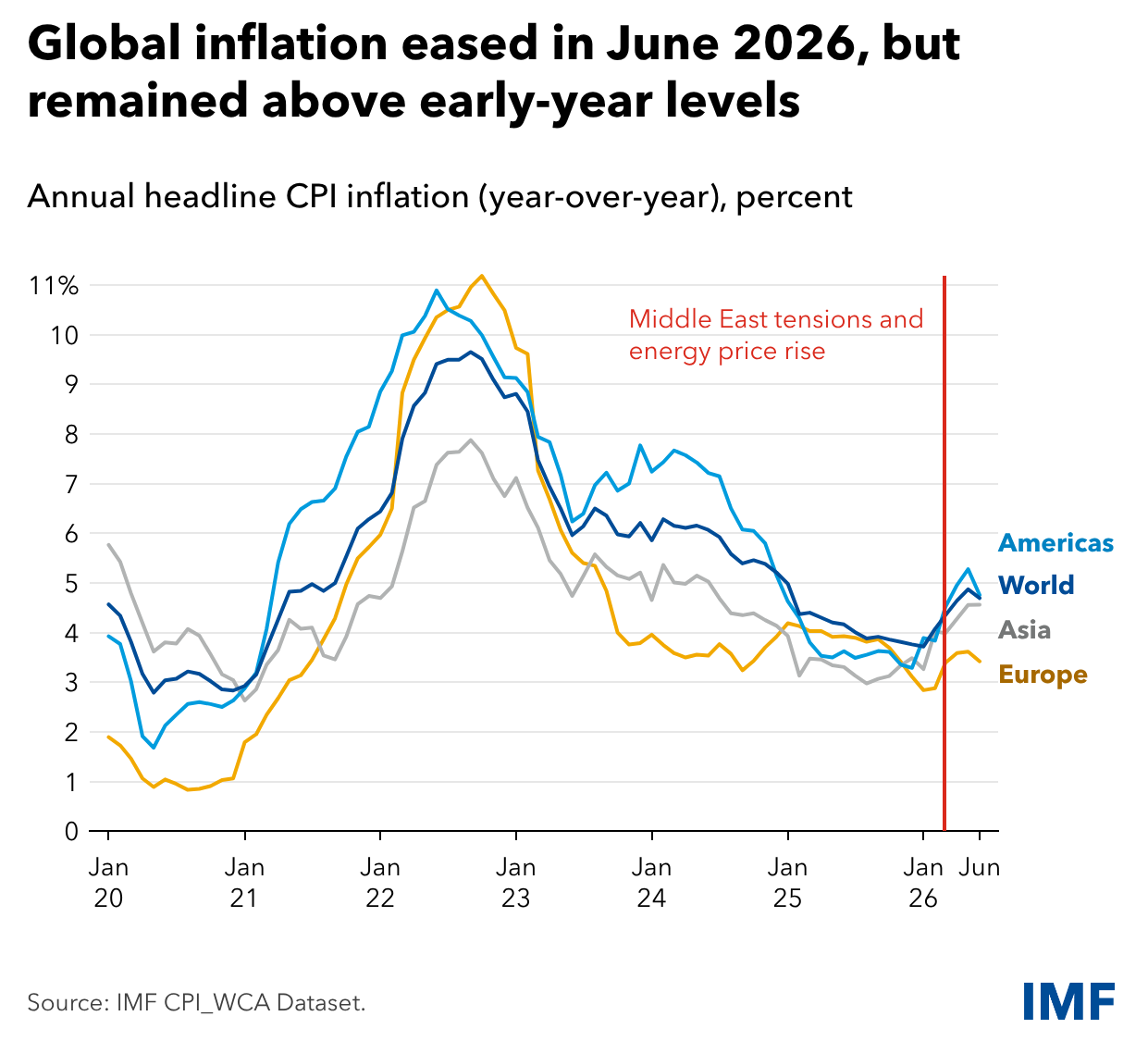
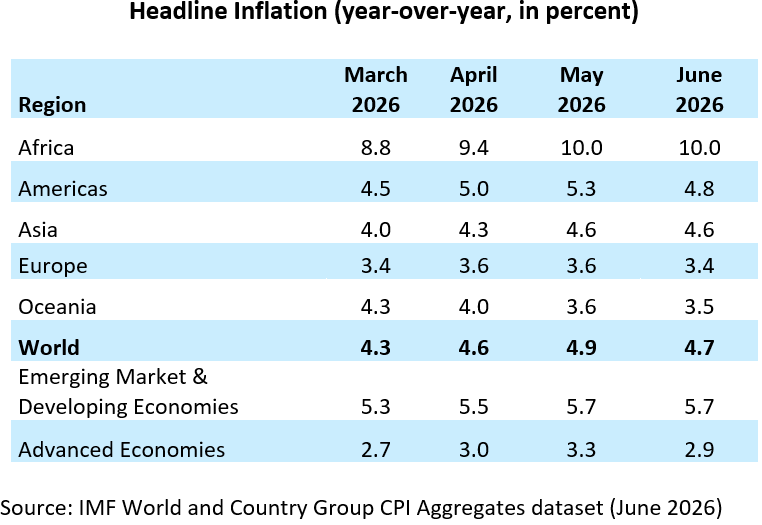
The World aggregate for annual headline inflation eased in June 2026, marking a modest cooling from May after increasing steadily since the start of the year. Global inflation increased from 4.3 percent in March to 4.9 percent in May, largely reflecting renewed upward pressure on energy prices amid rising tensions in the Middle East, before easing to 4.7 percent in June. Although this points to some easing in global price pressures by mid-year, global inflation remained above levels seen earlier in 2026.
The June easing was most evident in the Americas, Europe and advanced economies (AEs), while annual inflation was unchanged in Africa, Asia, and emerging market and developing economies (EMDEs). Annual inflation in EMDEs (at 5.7 percent) remained nearly twice as high as in AEs (at 2.9 percent) in June 2026.
At the regional level, Africa continued to record the highest inflation rate, at 10.0 percent in June. Inflation in the Americas declined from 5.3 percent in May to 4.8 percent in June, while Europe recorded a smaller decline, from 3.6 percent to 3.4 percent over the same period. In Asia, inflation remained at 4.6 percent in June.
Notes: The inflation estimates are published approximately two months after the reference period (latest release: June 2026) and cover end-of-period annual changes in consumer prices across all economies. The regional averages can hide substantial country divergence. Aggregated annual inflation is calculated using a geometrically weighted average of officially disseminated indexes, with annual PPP-adjusted GDP, lagged by one year, as weights. Coverage includes 165 economies worldwide, 46 in Africa, 33 in the Americas, 39 in Asia, 41 in Europe and 6 in Oceania. All aggregates are benchmarked to the World Economic Outlook (WEO) annual rates for 2025 and prior years, except for regional and G20 estimates, as these are not produced in the WEO.
EMPOWERING THE WORLD WITH DATA
IMF Data is known for its high standard of quality and methodological consistency. With over 50 datasets updated regularly, you always have access to the latest global economic trends and forecasts as well as trusted data for cross country research and analysis.
Check our release calendar for upcoming releases:
