

Publication date:
Feb 19, 2025
IMF Data Brief: Global Merchandise Exports
February 5 – 18, 2025
Global Merchandise Exports Decrease in November 2024 Driven by Emerging and Developing Asia
International Merchandise Trade Statistics, Country Group Aggregates, November 2024
(Contributors: Levan Karsaulidze and Arushi Kapoor)
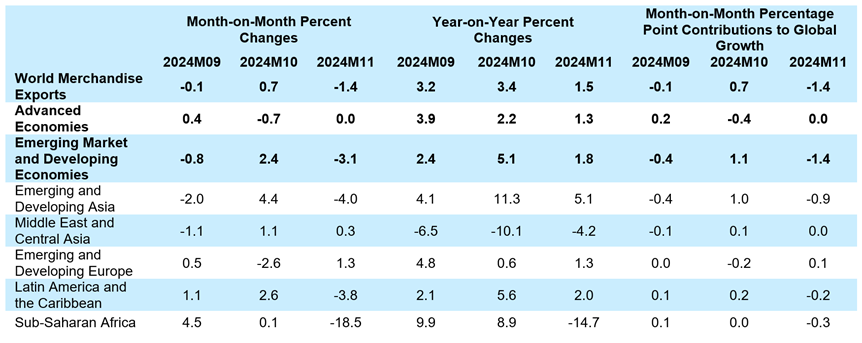
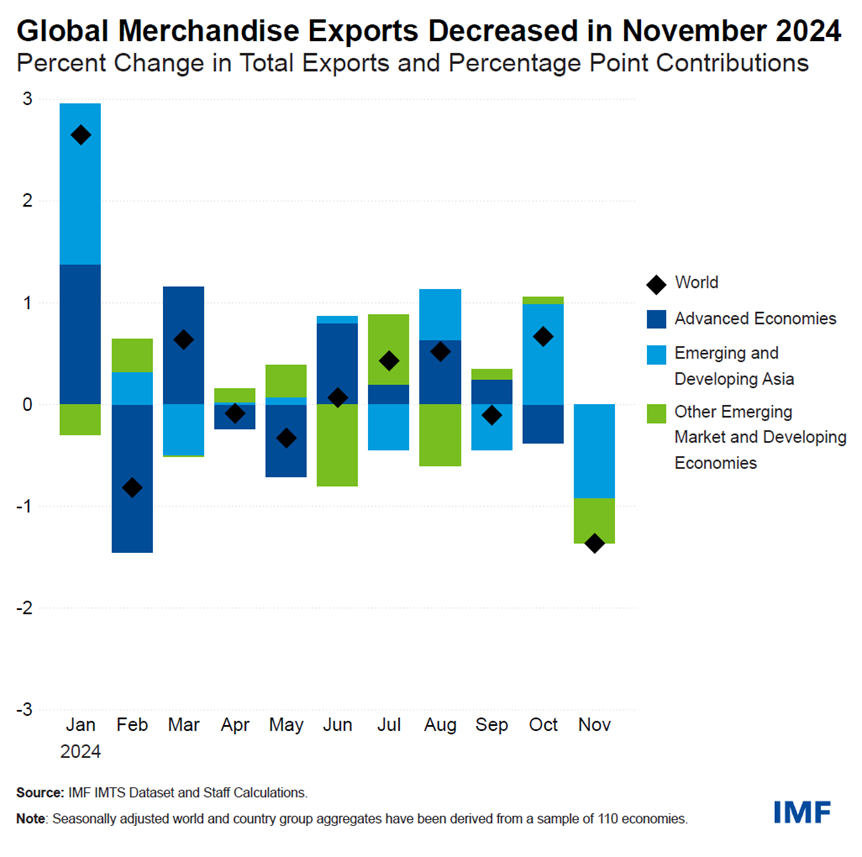
Seasonally adjusted global merchandise exports decreased 1.4 percent month-on-month in November, following an increase of 0.7 percent in October 2024. The decrease in November was mainly driven by Emerging and Developing Asia, where exports decreased 4.0 percent, subtracting 0.9 percentage point from global export growth.
A significant reduction was registered in Sub-Saharan Africa (-18.5 percent) contributing -0.3 percentage point to the global decline. Merchandise exports also decreased in Latin America and the Caribbean (-3.8 percent). Merchandise exports increased in Emerging and Developing Europe (1.3 percent) and in the Middle East and Central Asia (0.3 percent). Overall, merchandise exports declined 3.1 percent in Emerging Market and Developing Economies (EMDEs) and were unchanged for Advanced Economies (AEs).
On a year-on-year basis, global merchandise exports increased 1.5 percent with EMDEs and AEs registering 1.8 percent and 1.3 percent growth, respectively.
By income group, quarter-on-quarter real GDP growth in the Emerging Market and Developing Economies increased slightly to 0.9 percent in 2024Q3, up from 0.7 percent in 2024Q2. This group accounted for the majority of World GDP growth (0.6 percentage point). The Advanced Economies grew by 0.5 percent in 2024Q3, contributing 0.2 percentage point to overall growth.
Economy-wide prices, as measured by the World GDP deflator, grew by 1.8 percent in 2024Q3, similar to the 1.7 percent increase in the previous quarter (revised up from 1.6 percent). Price increases in the Americas (3.2 percent) and Asia (1.2 percent) contributed 1.4 percentage points to World price growth.
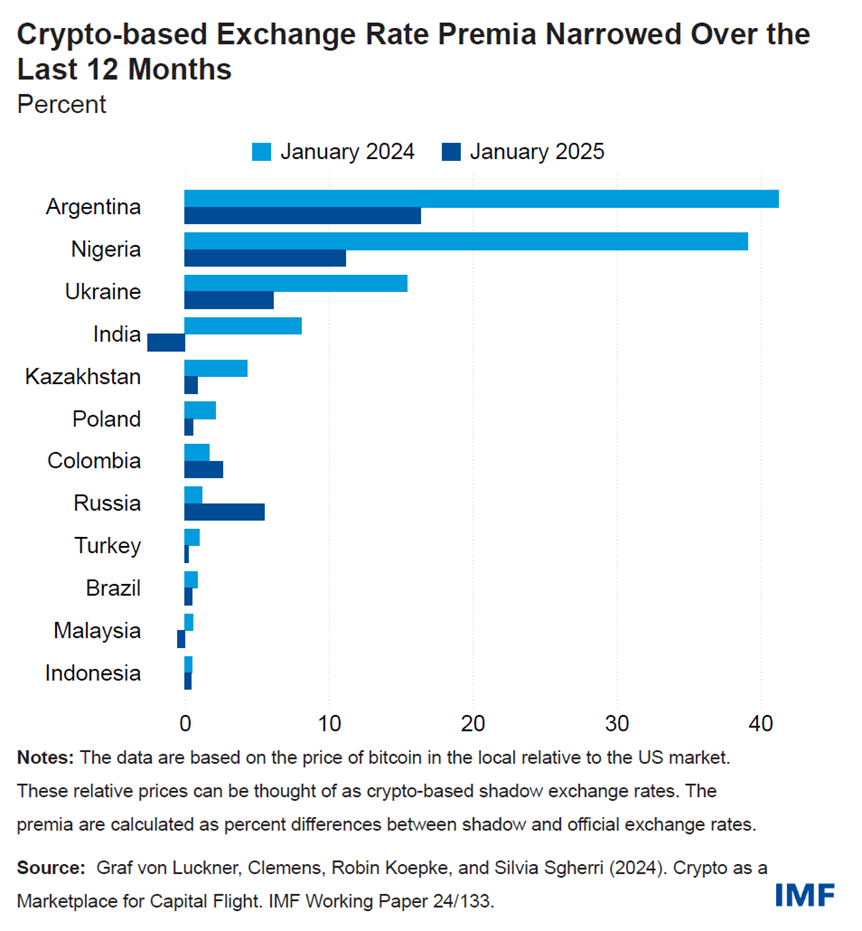
Updated Dataset: Crypto Pricing Reveals Narrowing Parallel Exchange Rate PremiaCrypto-based Parallel Exchange Rates; Country Data; January 2025
|
OTHER RELEASESAtmospheric CO₂ ConcentrationsCountry Data, Third Quarter 2024 Atmospheric CO₂ Concentrations for January 2025 were released on February 11, 2025. The IMF Climate Change Indicators Dashboard tracks monthly atmospheric carbon dioxide concentrations. |
EMPOWERING THE WORLD WITH DATA
IMF Data is known for its high standard of quality and methodological consistency. With over 50 datasets updated regularly, you always have access to the latest global economic trends and forecasts as well as trusted data for cross country research and analysis.
Check our release calendar for upcoming releases:
